
Which languages are spoken and learned most often on Sprachtandem.ch – and where do language goals complement each other particularly well? An analysis of 32,518 profiles reveals a community spanning 715 municipalities and localities, 73 spoken languages and some surprisingly strong language pairings.
32,518 profiles across all 26 cantons
A language tandem often starts with a very simple idea: one person speaks a language that another wants to learn – and vice versa. When thousands of these profiles are viewed together, they reveal a fascinating picture of linguistic diversity in Switzerland.
This analysis includes 32,518 profiles. They are spread across 715 municipalities and localities, cover all 26 cantons, and represent 73 different spoken languages. In total, 72 languages were also selected as learning goals.
The figures also show how multilingual many members already are. On average, a profile lists 1.59 spoken languages and 1.39 target languages. A tandem is therefore not always a simple exchange of “one language for one language”. Many people bring experience in several languages or pursue more than one learning goal at the same time.
New to the concept? What is a language tandem? explains how a language exchange works.
German is the most widely spoken language
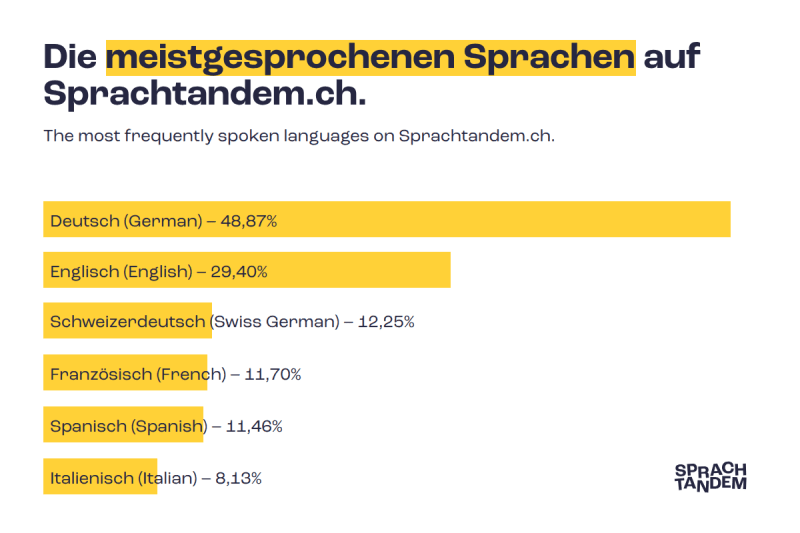
Almost half of all analysed profiles say they speak German. English follows in second place, with a considerable gap. The six most frequently spoken languages are:
- German: 15,891 profiles or 48.87%
- English: 9,559 profiles or 29.40%
- Swiss German: 3,984 profiles or 12.25%
- French: 3,805 profiles or 11.70%
- Spanish: 3,726 profiles or 11.46%
- Italian: 2,645 profiles or 8.13%
Because one profile can list several languages, the percentages do not add up to 100%. Instead, they show how often each language appears across the whole community.
The ranking reflects Switzerland’s distinctive linguistic landscape: alongside German, Swiss German, French and Italian are strongly represented. At the same time, international languages such as English and Spanish play a major role in the community.
The diversity reaches far beyond the largest language groups. Profiles also include Amharic, Tigrinya, Romansh, Tibetan, Pashto, Uyghur and Sign Language. At the rarest end of the analysis are Mandinka, Esperanto and Mongolian: each was listed exactly once as a spoken language. For groups this small, we deliberately do not publish additional combinations with location, age or gender.
Which languages does the community want to learn?
German also takes first place among learning goals. More than 14,000 analysed profiles want to build or improve their German skills. The strong demand for French is particularly striking as well.
The six most popular target languages are:
- German: 14,137 profiles or 43.47%
- French: 7,068 profiles or 21.74%
- English: 6,531 profiles or 20.08%
- Spanish: 4,570 profiles or 14.05%
- Swiss German: 2,898 profiles or 8.91%
- Italian: 2,838 profiles or 8.73%
German is therefore both the most widely spoken and the most frequently requested language on Sprachtandem.ch. French, by contrast, is selected as a learning goal far more often than it is offered as a spoken language.
The ranking also shows that people learn languages for many different reasons: to feel more confident in everyday life in Switzerland, broaden their career opportunities, communicate while travelling or simply explore a new language out of personal interest. The best methods for learning a new language gives an overview of different learning approaches.
French and Japanese are in particularly high demand
To see how closely supply and demand align, we can compare the number of profiles that want to learn a language with the number that say they speak it. These are not necessarily native languages: the analysis uses the languages that profiles report speaking or wanting to learn.
French has the largest absolute demand surplus:
- 3,805 profiles say they speak French.
- 7,068 profiles want to learn French.
- That is 3,263 more learners than speaking profiles.
Demand also clearly exceeds supply for Spanish: 4,570 profiles want to learn it, compared with 3,726 profiles that say they speak it. The difference is 844 profiles.
Japanese stands out even more in relative terms. 247 profiles say they speak Japanese, while 821 want to learn it. That works out at roughly 3.3 learners for every profile that speaks Japanese. Among the more sought-after languages, this is one of the tightest supply-to-demand ratios.
For French or Japanese speakers, that can be encouraging: anyone looking for a popular target language in return has a large pool of potential tandem partners. The figures do not, however, guarantee a suitable match. Location, level, interests, availability and preferred format all matter too.
German and English offer the greatest tandem potential
An even more tandem-focused question is which language goals complement each other in both directions. The most common one-way combination is:
Speaking German and learning French.
A total of 5,393 profiles list this exact combination. They are followed by:
- speaking English and learning German: 4,849 profiles
- speaking German and learning English: 4,004 profiles
- speaking German and learning Spanish: 3,820 profiles
- speaking Spanish and learning German: 2,740 profiles
- speaking German and learning Italian: 2,172 profiles
For a reciprocal tandem, however, both directions need to exist. We therefore also calculated a theoretical reciprocal matching potential. For example, the number of people who speak German and learn English is compared with the number who speak English and learn German. The smaller of the two groups limits the number of possible pairings.
The largest theoretical potentials are:
- German and English: up to 4,004 reciprocal pairings
- German and Spanish: up to 2,740 reciprocal pairings
- German and French: up to 2,094 reciprocal pairings
- German and Italian: up to 1,752 reciprocal pairings
These values are not the number of tandems that actually exist. They simply show how many profiles have potentially complementary language goals. Whether two people are truly a good fit depends on several other factors. Finding the Ideal Language Exchange Partner explains what to look for.
Zurich is the largest hub – but the community spans Switzerland
The largest local community is in Zurich. 11,211 analysed profiles are assigned to the city or municipality of Zurich. The next largest locations are:
- Zurich: 11,211 profiles
- Bern: 4,689 profiles
- Basel: 2,279 profiles
- Lucerne: 1,375 profiles
- Aarau: 948 profiles
Zurich and Bern together account for almost 49% of all analysed profiles. This highlights the importance of Switzerland’s major urban centres.
At the same time, Sprachtandem.ch has a much broader reach: profiles come from 715 municipalities and localities and from all 26 cantons. That means there are opportunities for in-person exchanges beyond the largest cities too. Where local choice is limited, an online tandem expands the search radius almost without limit.
Language learning is not just for students
Language tandems are often associated with university, study-abroad semesters or young adults. The age structure of the community paints a much broader picture.
The approximate median age is 38, while the average age is around 40. Among profiles with a plausible age, almost 72% are between 25 and 44 years old. The largest group is aged 35 to 44, followed by those aged 25 to 34.
This shows that language learning reaches far beyond school and university. A career change, a move, travel, personal relationships or simply the enjoyment of meeting new people can all be reasons to use another language actively at any stage of life.
The gender distribution is also relatively balanced. Among profiles that provided this information, around 57% identify as female and 43% as male; a small share selected the non-binary option. Around 15% of analysed profiles did not provide a gender.
More than one in three profiles is open to online tandems
11,170 profiles explicitly say they are also willing to learn online. That represents 34.35% of all analysed profiles – more than one in three.
Online tandems are especially useful when the desired language is rarely represented locally, when regular in-person meetings are difficult to schedule or when two suitable people live in different regions. They can also complement face-to-face meetings.
Not selecting the online option does not automatically mean that a profile wants in-person meetings only. The safe conclusion is simply that more than a third explicitly activated the online option. Learning Languages Online: How to Do It Right shows how to make digital conversations productive.
The community continues to grow
The analysis shows not only a large profile base built over many years, but also a continuing flow of new registrations. In 2025, 3,218 analysed profiles were created. From 1 January to the reference date of 28 August 2026, another 2,338 profiles had already been added.
The 2026 figure covers only part of the year and cannot yet be compared directly with a full calendar year. It does, however, show that language exchange continues to attract interest – for the major national languages as well as international and less common languages.
What these figures mean for your tandem search
Above all, the statistics show that every ranking represents people with different experiences, goals and stories. The largest language group is not automatically the best choice for you, and a rare language does not have to be a barrier.
Three questions can help you search successfully:
- Which language can you confidently bring to a tandem?
- Which language do you want to use in real conversations?
- Would you prefer to meet in person, speak online or combine both formats?
The more clearly your profile answers these questions, the easier it is for suitable people to find you. Use the tandem search to filter by language, location, age, gender and exchange format.
Whether you exchange German for French, English for Spanish or form a much rarer combination, a good language tandem does not begin with perfect skills. It begins with two people who are willing to speak regularly and learn from each other.
How the analysis was carried out
The analysis is based on Sprachtandem.ch data as of 28 August 2026. It includes 32,518 profiles linked to a confirmed, non-blocked user account.
The following points are important when interpreting the results:
- The figure refers to analysed profiles, not monthly active users.
- Language information is self-reported by profile holders.
- Multiple selections are possible, so language shares can add up to more than 100%.
- Municipalities were grouped using their official Swiss municipality number wherever possible.
- Age was approximated from year of birth and is not exact to the day.
- The matching potential is purely theoretical and does not account for activity, location, age, interests, proficiency level or availability.
- No additional characteristics were combined or published for very small language groups.